What Does a Home Rendering Cost?
Nobody enjoys the answer "it depends," so here is a number first.
A photorealistic home rendering typically runs $1,000 to $2,500 per image. That is the rendering itself — lighting, materials, furnishing, composition, and the iteration required to get it right. It does not include building the 3D model, which is quoted separately because it varies more than anything else in the process. That range describes a single image of a single view.
Now the useful part: what moves a project from one end of that range to the other. Almost none of it is what people expect.
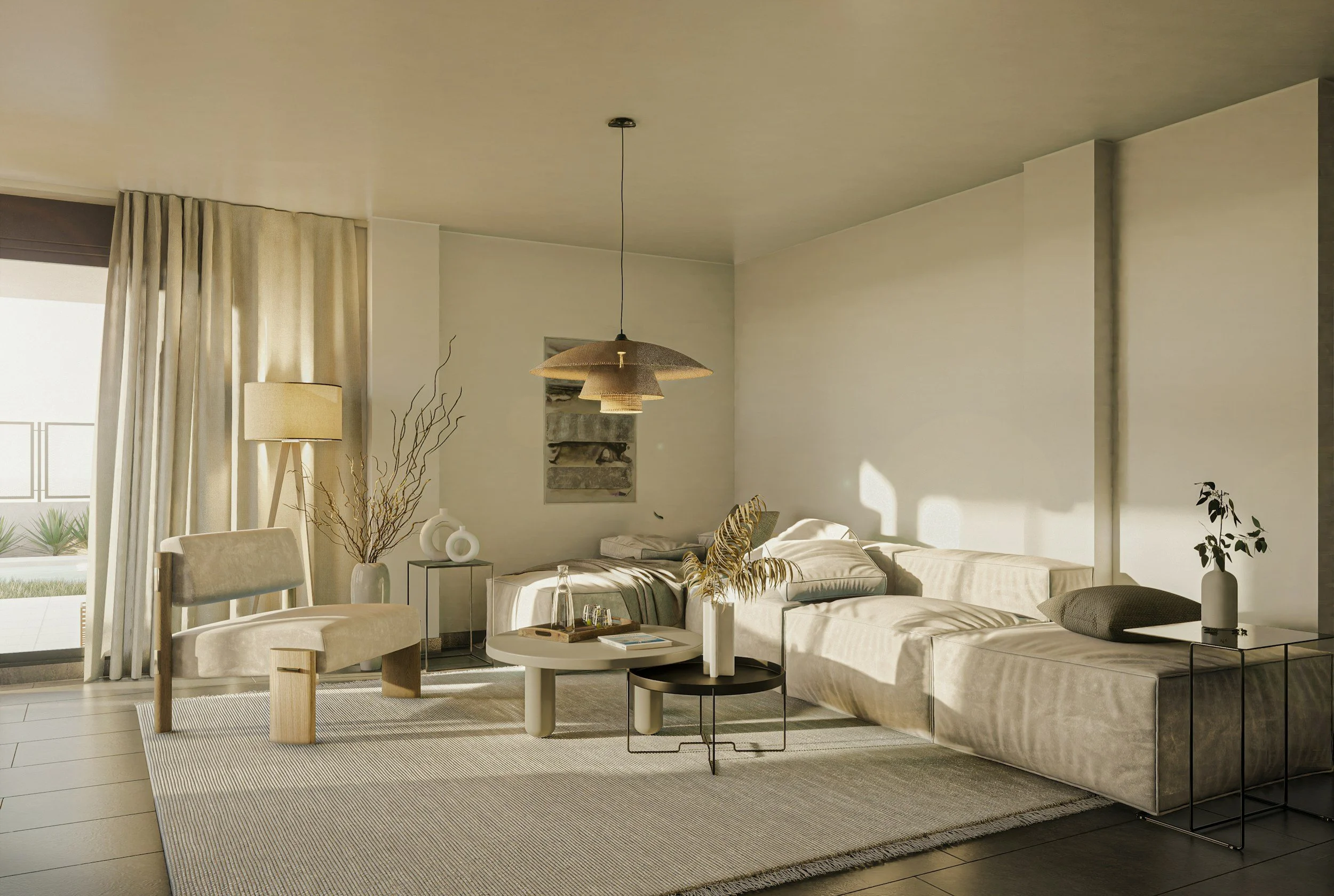
It Is Not Really About the Picture
Clients tend to assume the cost of a rendering is the cost of the render — the hours a machine spends computing light. It isn't. Machine time is close to free and getting freer. What you are paying for is the time a person spends making decisions, and the number of decisions is set by how much of the design is not yet decided.
How Much Is Already Decided
This is the single largest variable, and it is almost entirely within a designer's control. A project where the stone is chosen, the fixtures are specified, the paint has a name, and the furniture has model numbers is a project where a rendering is largely execution. We build what the schedule says. A project where the client is "thinking warm woods, maybe" is a project where someone has to choose the wood, present it, be told it's too red, and choose again. That work has value — it is genuinely part of design — but it is billed by the hour it takes, and it is the reason two visually similar images can differ by fifteen hundred dollars. If you want a rendering to cost less, arrive with your specification finished. This is the whole trick.
Revisions and Exploration
Related, but distinct. Revisions are corrections against a settled design: the sofa is the wrong grey, the pendant hangs too low. These are cheap and expected, and a normal engagement includes a couple of rounds. Exploration is different. Three furniture layouts. Two lighting schemes. The kitchen in walnut and again in white oak. Each variant is a separate image with its own setup, and it is priced that way. Exploration is often the correct investment — deciding on screen is enormously cheaper than deciding on site — but it should be a decision rather than a surprise.
How Closely You Need to Work With the 3D Designer
Some interior designers and architects hand off a package and want a finished image back in ten days. Others want to sit in the model, move things, and iterate through the week. Both are legitimate. The second costs more, because it consumes calendar and attention rather than just production hours. It also usually produces a better image, because the person with the design judgment is in the room while the decisions are being made. Say which one you want at the outset. The mismatch between an expected handoff and an actual collaboration is where budgets and relationships both go wrong.
D5 or Corona: Speed Against Realism
Rendering engines are not interchangeable, and the choice between them is a direct trade of time for realism. It belongs to the client, not to us. D5 is a real-time engine. It is fast, it looks very good, and it lets us move a camera or swap a material and see the result immediately. When a client needs images this week — a decision to make, a meeting to hold, a listing to launch — D5 is the answer, and its speed is what makes iteration affordable. The trade is a small concession in realism, most visible in the way light bounces through glass, water, and complex reflective materials. Corona is an offline engine that computes light exhaustively. It is where we go when the image simply has to be real: subtle indirect lighting, difficult caustics, intricate material work, high-resolution stills destined for print or for a client who will study them at arm's length. Corona is slower to set up and slower to compute, and that time appears on the invoice. Neither is the default. A designer who needs three layout options by Friday should be in D5. A developer whose hero image will sell a landmark home should be in Corona. Most projects tell you which they are within the first conversation, and we will say plainly which one we think you need.
What This Buys You
Against the cost of a house, a rendering is a rounding error that changes decisions. A window aimed at a neighbor's garage costs hours to fix on screen and considerably more after framing. A client who hesitates for six weeks over a kitchen they cannot picture is a client whose carrying costs exceed the rendering.
Talking About Your Project
Every project is different and this range is a starting point, not a quote. Tell us what exists — a sketch, a model, a specification, a deadline — and we will tell you honestly what it will take, including when a rendering is not the right spend at all. Reach us through Lunix3D.com.